Inverter-based engine drives are showing reliability issues in the field. Vibration, heat, dust, moisture, and inconsistent engine speeds are exposing the limits of a design built for the stable power of a shop floor — not a jobsite.
The Vanair® Air N Arc® 330 Diesel ALL-IN-ONE Power System® was engineered for a different reality. Powered by Lincoln Electric’s proven Chopper Technology®, it is built from the ground up for mobile, high-abuse applications where uptime is essential.
The core question that should be asked: How does a machine separate its weld circuit from its auxiliary power circuit, and what does that design choice mean for durability in the field?
The answer to that question is where the Air N Arc® 330 Diesel separates itself from the competition.
How Circuit Separation Defines Durability
Both Chopper Technology® and inverter technology separate the weld circuit from auxiliary power, but through fundamentally different architectures. Those differences have real consequences for field reliability.
Chopper Technology®: Two Windings, Two Jobs
The Air N Arc® 330 Diesel uses a dual-winding alternator. One winding handles weld output exclusively. The other handles auxiliary power. Each circuit is physically separated and insulated at the alternator level, with no electronic conversion stages required to maintain isolation.
The system generates a low weld voltage (approximately 77 VAC, rectified to ~105 VDC) and uses high-frequency IGBT switching to control weld current precisely. Lower voltage means lower electrical stress on every component in the weld circuit — and that margin compounds over thousands of hours of field use.
Inverter-Based Designs: Higher Stakes
Many competing engine drives use a single-winding alternator that generates high-voltage power (up to ~400 VDC), then converts it through an inverter and transformer to produce weld output. The smaller alternator reduces machine weight — a real advantage in some applications.
The trade-off is reliability. More conversion stages mean more components exposed to:
- Constant vibration from road travel and jobsite terrain
- Dust and debris ingestion in open environments
- Heat cycling from high ambient temperatures and heavy load cycles
- Moisture from weather, washdowns, and condensation
- Engine speed variability including overspeed events and startup/shutdown stress
Shop-based inverter welders run on stable utility power. Engine-driven inverters do not. Every one of those variables adds cumulative stress to sensitive electronics, and that stress shows up as downtime.
Chopper vs. Inverter: Side-by-Side Comparison
The question is not which technology is superior in a lab. It is which one holds up best in engine-driven, mobile applications. For dealers helping customers spec the right machine, that context is everything.
| Factor | Air N Arc® 330 Diesel (Chopper Technology®) | Inverter-Based Engine Drives |
|---|---|---|
| Circuit separation | Dedicated alternator windings, physically isolated | Single winding with electronic conversion stages |
| Weld voltage | Low (~77 VAC / ~105 VDC) | High (up to ~400 VDC) |
| Component stress | Lower, by design | Higher, due to conversion requirements |
| Vibration sensitivity | Lower, simpler architecture | Higher, more sensitive electronics |
| Engine speed sensitivity | Lower | Higher |
| Weight profile | Heavier, more robust build | Lighter, more compact |
| Best fit | Rugged field and mobile use | Shop-based or weight-critical applications |
Key takeaway: When a customer’s priority is uptime in tough conditions, the Air N Arc® 330 Diesel makes the reliability conversation straightforward. Most field service applications prioritize uptime over weight savings.
For guidance on matching machine design to operating environment, see Choosing the Right Engine Driven Welder, which covers fuel type, duty cycle, auxiliary power output, and more.
What the Air N Arc® 330 Diesel Delivers on the Jobsite
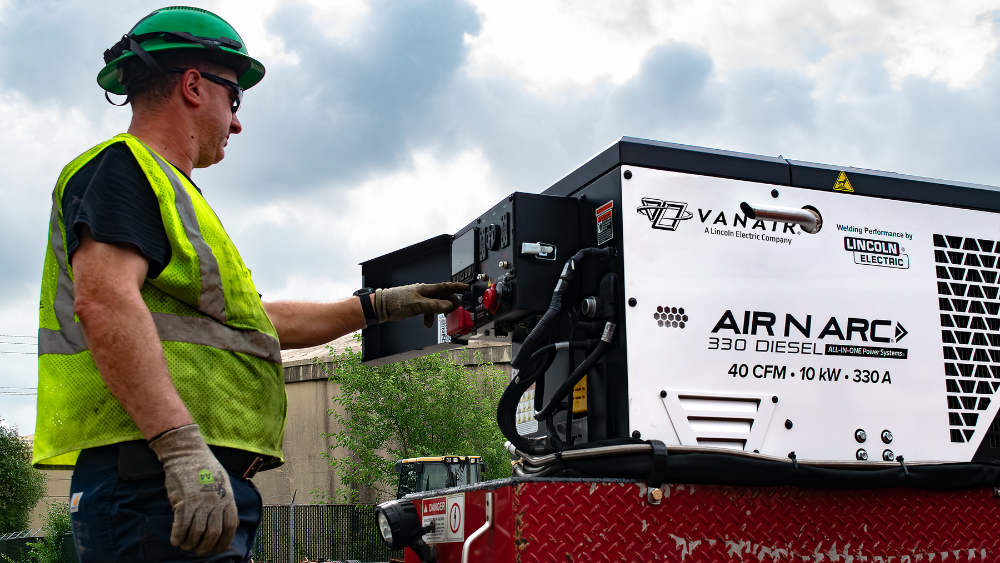
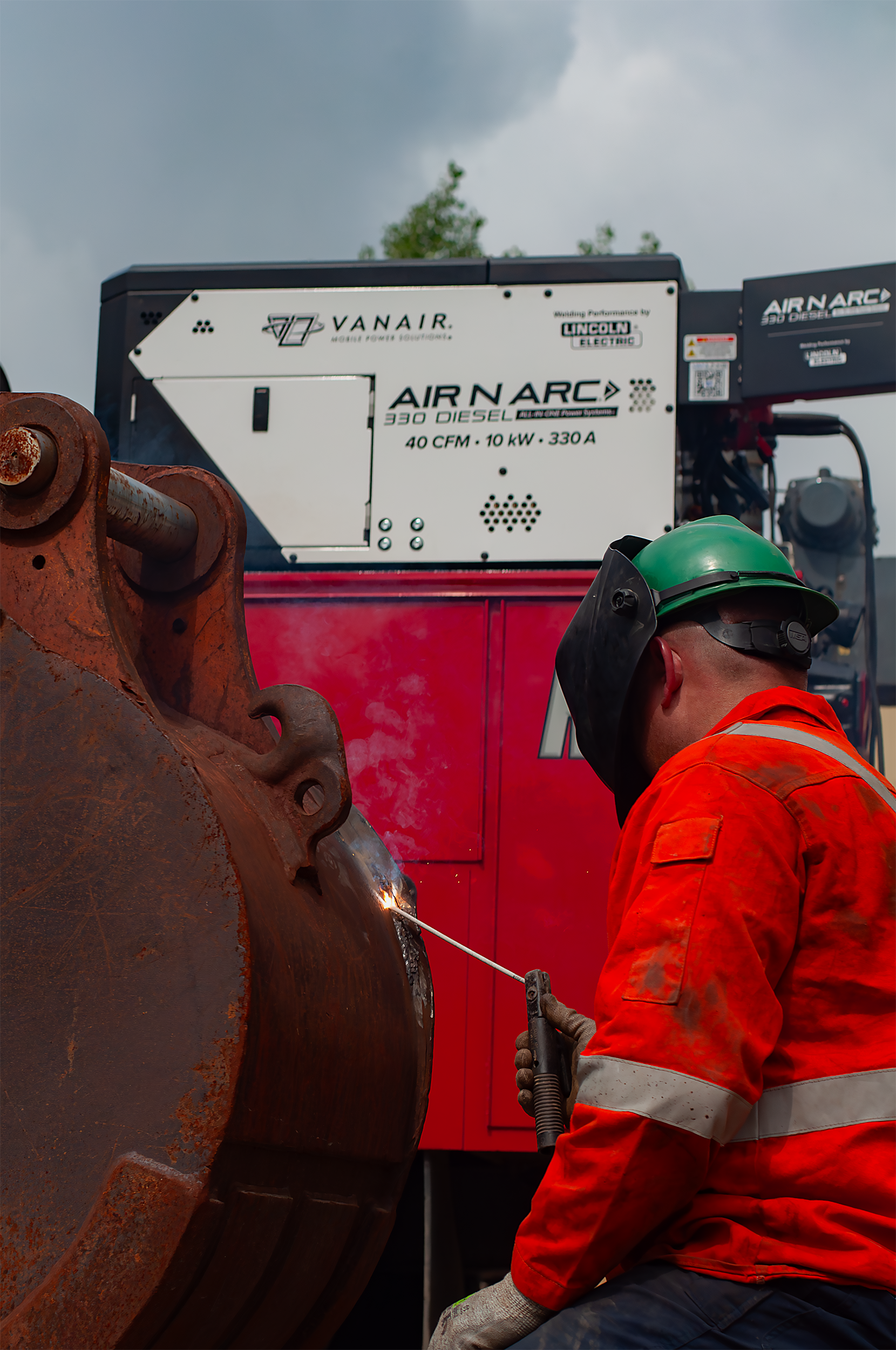
The Air N Arc® 330 Diesel is not just a welder. It is a complete Air N Arc® ALL-IN-ONE Power System® that integrates five forms of power into a single truck-mounted unit.
Five Forms of Power, One Machine
- Air compressor: Rotary screw, 40 or 60 CFM at 150 PSI (up to 175 PSI), air-on-demand
- Welder: Lincoln Electric DC multi-process, 35-330A CC (Stick, Gouging, TIG) and 14-40V CV (MIG, FCAW)
- Generator: 10kW continuous, 120/240V, 60Hz, smooth wave AC
- Battery booster: 330A, 12V/24V
- Battery charger: 50A, 12V/24V/48V, with up to 50A chassis charge back
Powered by a 24.8HP Kubota® 3-cylinder water-cooled diesel engine with Tier 4F compliance and electronic variable speed. Mounts on a side pack or behind the cab: 47.5 x 21.4 x 25.6 inches, 750 lbs dry.
 Built for the Conditions That Break Other Machines
For fleet operators in utility, construction, and heavy equipment maintenance, the durability advantage is direct:
- True circuit separation at the alternator level, no electronic isolation stages to degrade
- Lower-voltage weld architecture reduces stress on every component
- Field-proven design built for engine-driven applications, not adapted from a shop platform
- Consistent arc performance regardless of engine speed variation or environmental exposure
Those characteristics translate to fewer service calls, less downtime, and a lower total cost of ownership over the machine’s working life.
The Bottom Line
For mobile, high-abuse, field-service applications where conditions are unpredictable and downtime is expensive, the design simplicity and inherent durability of Chopper Technology® win.
The Air N Arc® 330 Diesel ALL-IN-ONE Power System® is built for the jobsite as it actually exists. True circuit separation, lower-voltage architecture, and a field-proven design add up to a machine dealers can confidently recommend and end users can depend on shift after shift.
When conditions get tough, Chopper Technology® keeps working.
Get a quote on the Air N Arc® 330 Diesel or explore the full Air N Arc® ALL-IN-ONE Power System® lineup to find the right configuration for your application.