Key Takeaways:
- Reciprocating air compressors use pistons that move back and forth to pull in and compress air.
- Rotary screw air compressors are composed of a male and a female helical screw that spin closely together to draw in and compress air.
- Rotary screw and reciprocating compressors offer diverse benefits to suit different application needs.
Air compressors are invaluable to hundreds of different applications. These applications can include small-scale service operations, to large industrial mobile applications. Depending on your needs, there are two major air compressor types: reciprocating air compressors and rotary screw air compressors.
How does a reciprocating air compressor work?
Reciprocating compressors are configured using pistons that move back and forth to draw in and compress the air. The air is pressurized and pushed through a discharge valve and into an air tank or reservoir for use.
Reciprocating air compressors do not often operate at 100% duty cycle, as they are designed for intermittent use and would risk overheating, rapid mechanical wear from many moving parts, and other consequences.
How does a rotary screw air compressor work?
A rotary screw compressor works by using an assembly of two double-helix shaped screws, one male and one female, that spin closely together at a rapid rate to draw in and compress air. Confined in a chamber known as a “stator,” these screws are separated by a thin layer of oil for proper cooling and lubrication to prevent the system from overheating or locking up.
Rotary screw compressors offer a continuous flow of compressed air, with the ability to operate equipment at 100% duty cycle. This means it does not always require an air tank for use, since it will keep pushing out compressed air, rather than a reciprocating compressor designed for use in intervals. It also contains few moving parts, leading to less maintenance than a reciprocating compressor may require.
When is it best to use each?
At the surface, it may seem that rotary screw compressors are the ideal choice for any application since air power can be more readily available. On the contrary, while a rotary screw setup may offer continuous air, it is not designed for stop-and-start air uses that many applications depend upon.
Rotary screw compressors are designed for use during long periods of time and require ample time to cool before starting up again for their next use. They are ideal for applications such as irrigation services, sewer rehabilitation services, cured-in-place pipe (CIPP), and more.
Reciprocating compressors are more useful for this stop-and-start use, such as powering impact wrenches, air hammers, grinders, and other pneumatic tools used for short periods of time. They also do not require as much cooling time at once as a rotary screw compressor would.
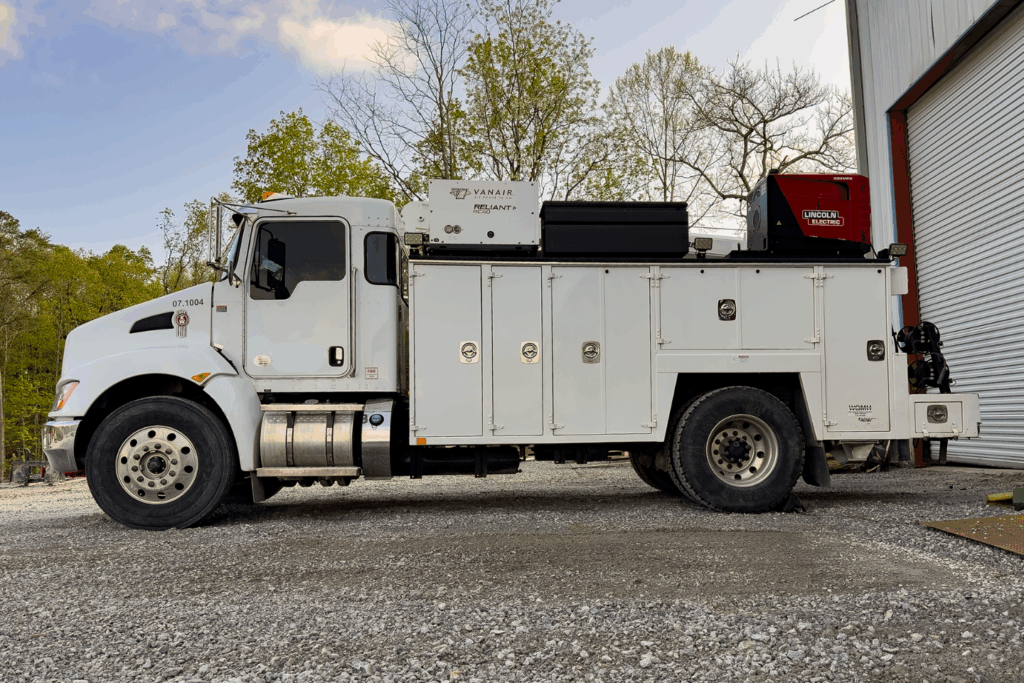
The right air compressor for your application’s needs is highly variable, but understanding the differences between these types can help you find the exact air compressor you need. Vanair®, a Lincoln Electric Company, offers a wide array of both rotary screw and reciprocating mobile air compressors. These machines, designed for various mobile service applications, are built in many configurations powered by gas, diesel, battery electric EPEQ® Electrified Power Equipment®, hydraulics, or PTO shaft-driven underdeck power.