Integrated system of LiFePO4 batteries, inverters, and solar panels offers over-the-road fleets a scalable alternative to traditional APUs, with a focus on extending equipment life and reducing maintenance costs.
NASHVILLE, Tenn., March 15, 2026 — Vanair®, a Lincoln Electric Company, is bringing its EPEQ® Electrified Power Equipment® ecosystem to the Class 8 trucking segment with a suite of battery-electric solutions designed to power sleeper cab hotel loads, support liftgate and refrigeration batteries, and reduce engine idling across over-the-road fleets. The products were presented at a press conference at TMC’s 2026 Annual Meeting & Transportation Technology Exhibition at the Music City Center.
Vanair’s EPEQ® product line has been a proven platform in the vocational work truck market since 2020, providing zero-emission, battery-driven air compressors, welders, hydraulic power and AC power for service vehicles, utility trucks and mobile maintenance fleets. With the addition this year of new 12-volt batteries and inverters, a patented solar charging system and upgraded IP67-rated 48-volt batteries designed for frame-rail mounting, the EPEQ® ecosystem now has the range and durability to serve Class 8 applications where idle reduction and auxiliary power are critical.
The expansion comes as over-the-road fleets face intensifying pressure on two fronts. First, fleets are holding onto trucks longer. Higher replacement costs and constrained capital are stretching rotation cycles that once averaged seven to 10 years to 12 years and beyond, making every hour of unnecessary engine wear more consequential. Second, the electrical demands inside the cab continue to grow. Telematics, GPS, electronic logging devices, in-cab entertainment systems and HVAC all draw power that traditional charging systems struggle to replenish, particularly during mandatory rest periods when the engine must be shut down. Fleet maintenance teams report that battery and electrical failures are among the most frequent issues on aging equipment, and the downstream costs in downtime, service calls and premature battery replacement add up quickly.
“Vanair® has spent more than five decades providing its ‘Mobile Power Solutions®’ for work truck and vocational fleets, and the challenges facing Class 8 fleets are fundamentally the same,” said Chip Jones, National Manager of the Electrified Products Group for Vanair®. “Drivers need reliable heating, cooling and electrical power without running the main engine. Fleets need to protect expensive assets from the wear that idling causes. What we bring to this market is not a single-purpose APU. It’s a complete, integrated power ecosystem that scales to the application.”
EPEQ® for Class 8: A Modular Approach to Auxiliary Power
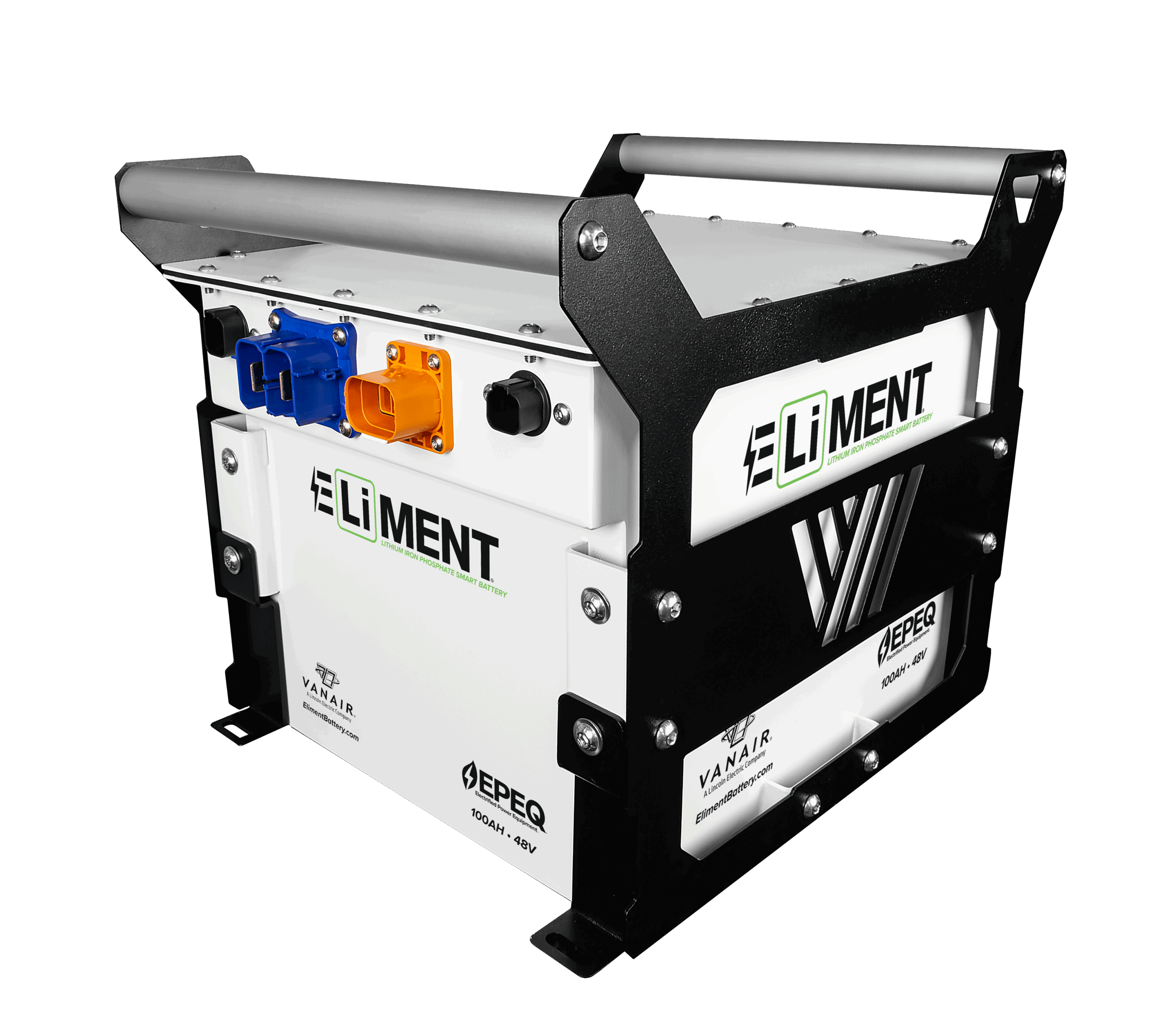
The 48V ELiMENT® Battery is now upgraded with IP67-graded enclosures for complete protection against dust and water immersion.
At the core of the EPEQ® system are Vanair’s ELiMENT® lithium iron phosphate (LiFePO4) batteries. The 48-volt batteries, now upgraded with IP67-rated enclosures for complete protection against dust and water immersion, are available in 5kW modules that can be run in parallel up to 30kW to match the power and runtime demands of any application. New mounting configurations allow the batteries to be installed directly on a Class 8 frame rail, where they are exposed to road spray, mud and debris. A dedicated solar input and telematics output are built into the battery management system, and an updated mobile app provides real-time monitoring of battery health, state of charge and system diagnostics.
For sleeper cab applications, EPEQ® inverters convert stored battery power to run HVAC systems, refrigerators, microwaves, entertainment systems and other hotel loads throughout a full 10-hour rest period without idling. The system charges from the truck’s alternator while driving and can also be replenished via shore power when the vehicle returns to the yard. Unlike traditional diesel APUs, the EPEQ® system has no fuel-burning engine, no exhaust, no additional fluid maintenance requirements and significantly lower noise output.
12-Volt Batteries and Inverters for Lighter Auxiliary Loads
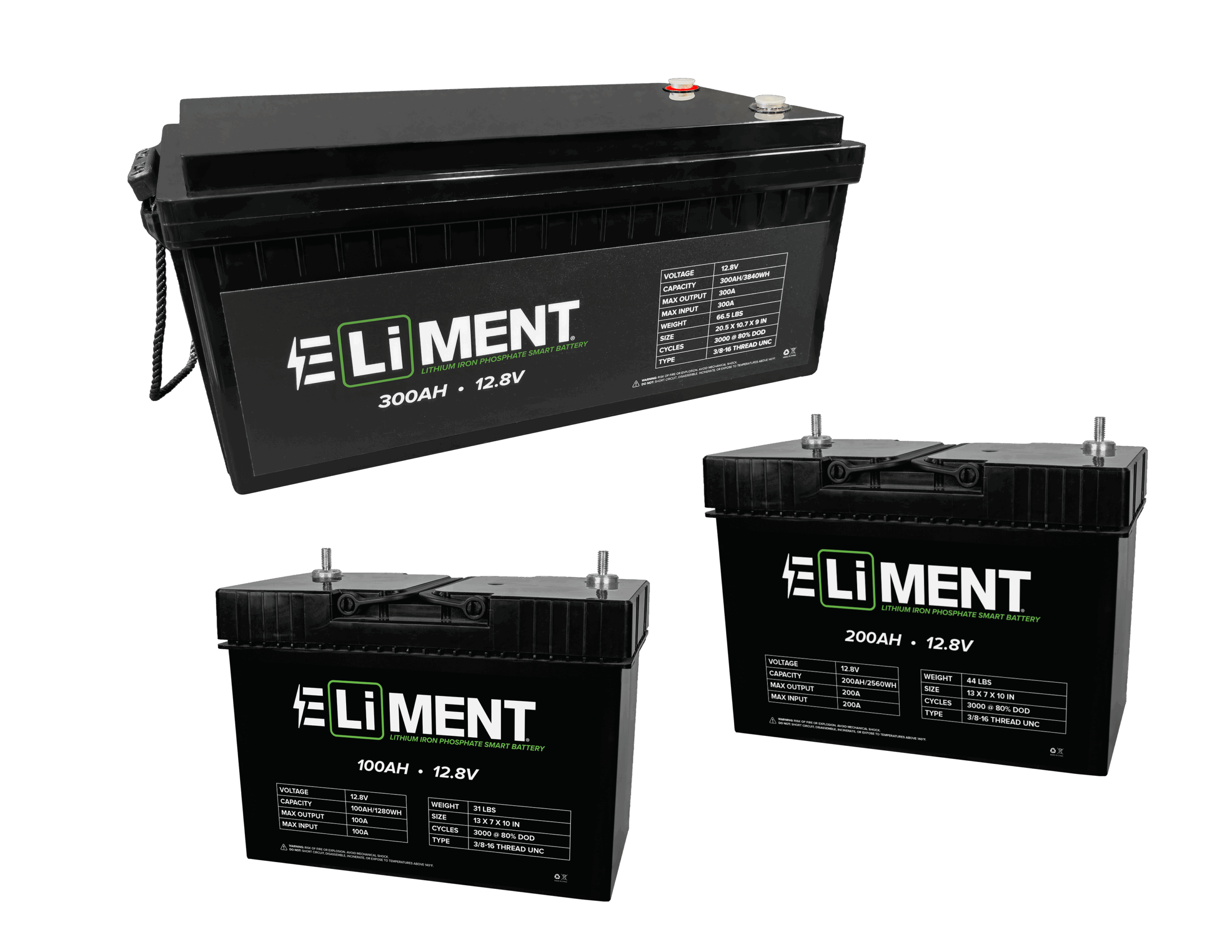
12V ELiMENT® Batteries available in 100Ah, 200Ah, and 300Ah configurations.
The new EPEQ® 12-volt product line, introduced at Work Truck Week 2026 the previous week, also has direct relevance for Class 8 fleets. ELiMENT® 12-volt LiFePO4 batteries in 100 Ah, 200 Ah and 300 Ah configurations, paired with pure sine wave inverters in 1,000W, 2,000W and 3,000W models, provide isolated auxiliary power for day cab applications, regional haul trucks and fleet maintenance vehicles where a full 48-volt system is not required. Common uses include powering onboard electronics, charging cordless tools and running 120-volt equipment.
EPEQ® Solar Assist™: Integrated and Standalone Solar for Heavy-Duty Fleets
EPEQ® Solar Assist™, Vanair’s patented solar panel system, is being positioned for the Class 8 segment as both an integrated component of the EPEQ® ecosystem and as a standalone product. The flexible, adhesive-mounted panels utilize a shade-resilient mesh grid with more than 2,100 conductive pathways, delivering strong energy production in the low-angle, diffuse and partial-shade conditions common on trucks in motion. At 1/8-inch thick, the panels conform to cab fairings, trailer rooftops and other curved surfaces without raised mounting platforms and are durable enough to survive more than 130,000 vibration cycles. Direct-fit configurations are available for major OEM platforms including Freightliner, Kenworth, Peterbilt, International and Volvo.
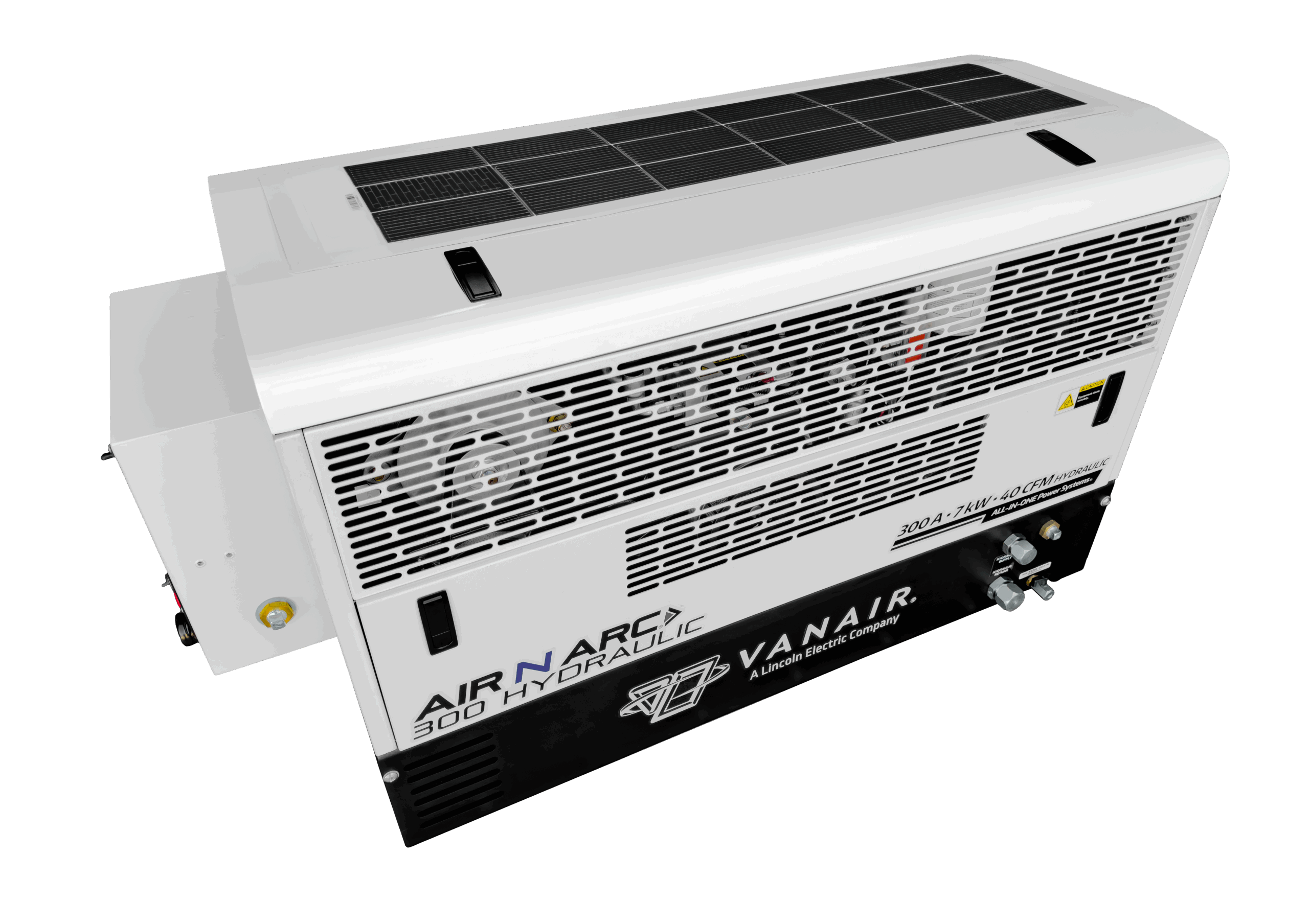
The EPEQ® Solar Assist™ shown on an Air N Arc® 300 Hydraulic ALL-IN-ONE Power System®.
As a standalone battery tender, Solar Assist™ addresses one of the most persistent and costly problems in fleet maintenance: progressive battery depletion. Vehicles parked over weekends, holidays or between loads continue to draw power from telematics, ELD systems, GPS, tire pressure monitoring and security systems. These parasitic loads silently drain batteries, leading to no-starts, jump-start calls and premature replacements. Fleet data shows that solar battery tending can extend battery life by up to 200% and help eliminate the one to two battery replacements most fleets budget per vehicle over a typical rotation cycle. Each Solar Assist™ system includes Maximum Power Point Tracking (MPPT) charging, which harvests up to 45% more energy than standard Pulse Width Modulation (PWM) controllers. The system’s charge controller supports voltages from 12-volt through high-voltage applications, enabling it to supplement power for liftgate batteries, electric APU batteries and refrigeration units on trailers.
EPEQ® EPTO: Battery-Driven Hydraulic Power
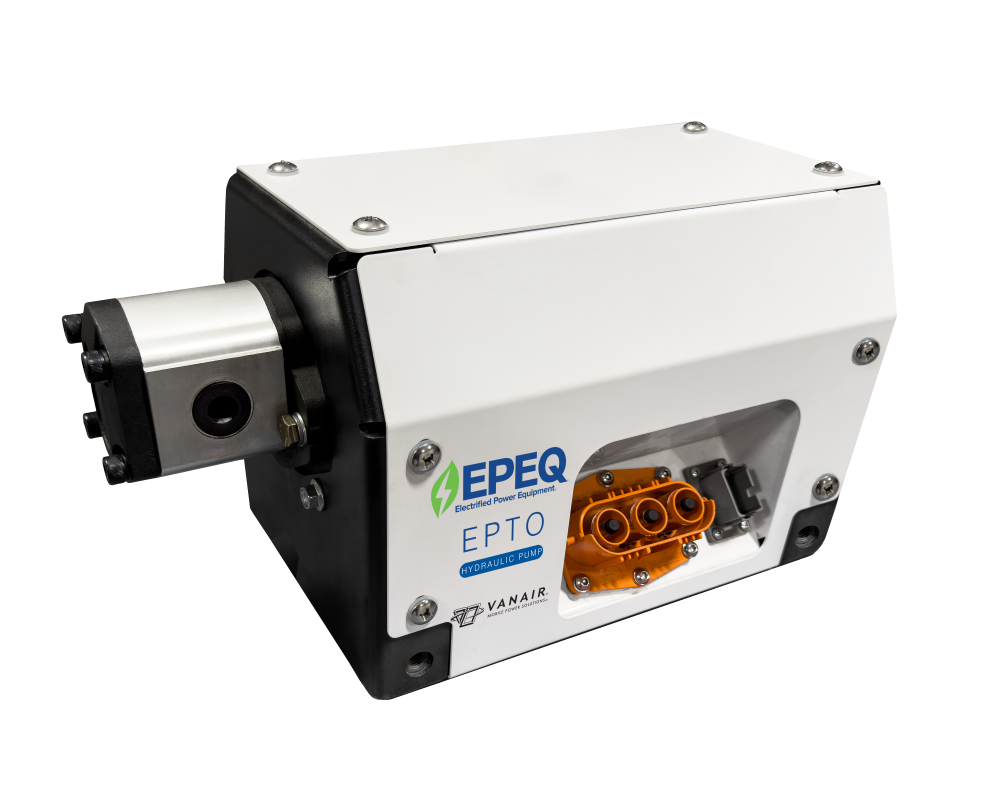
EPEQ® EPTO delivers up to 9 GPM of hydraulic flow from the battery system.
For flatbed, tanker and specialty carriers, the EPEQ® EPTO delivers up to 9-gallons per minute of hydraulic flow from the battery system, enabling operators to run pumps, liftgates, compressors, blowers and other hydraulic equipment without idling the truck engine. Combined with the IP67-rated ELiMENT® batteries, the EPTO provides a quiet, zero-emission hydraulic power source that can be frame-mounted and operated independently of the vehicle’s drivetrain.
“Most of the electric APU solutions on the market today do one thing: handle hotel loads,” said Jones. “The EPEQ® ecosystem does that, but it also provides air compressor power, hydraulic power, solar charging and idle management in a single, integrated architecture. And because every component is engineered to work together, fleet maintenance teams deal with one supplier and one phone call if there’s ever an issue. That’s a meaningful difference when you’re managing thousands of trucks.”
Vanair’s EPEQ® product line and Solar Assist™ system will be on display in the Vanair® booth at TMC’s 2026 Annual Meeting & Transportation Technology Exhibition, March 16–19, at the Music City Center in Nashville. For more information, visit vanair.com.
About Lincoln Electric
Lincoln Electric is a high-performance industrial machinery and technology leader who helps customers manufacture and maintain vital equipment and infrastructure. Lincoln Electric’s innovative solutions enable higher quality and productivity across a variety of processes including welding, cutting, brazing, machining, process automation, and field repair. The Company leverages proprietary technologies and expertise in materials science, power electronics, automation, and intelligent software to help customers build better and achieve resilience in their operations. Headquartered in Cleveland, Ohio, Lincoln Electric is the essential ‘Linc’ that keeps the economy running. The Company operates 71 manufacturing and automation facilities across 20 countries and serves customers in over 160 countries. For more information about Lincoln Electric and its products and services, visit the Company’s website at https://www.lincolnelectric.com.
About Vanair®
Vanair® offers an extensive product line of vehicle-mounted air compressors, generators, welders, hydraulics, Electrified Power Equipment®, chargers/boosters, engine starters, EV chargers and custom products, making it the most comprehensive Mobile Power Solution® provider in the world. Through innovative design, training and support, Vanair® delivers rugged and reliable products that enhance efficiency and productivity globally. Wherever, whenever and however you need it… Vanair® is there. For more information about Vanair® and its products and services, visit the Company’s website at https://vanair.com/.
Vanair®, the Vanair® logo, Mobile Power Solutions®, EPEQ®, Electrified Power Equipment®, ELiMENT®, and Solar Assist™ are registered trademarks or trademarks of Vanair®, a Lincoln Electric Company, Michigan City, IN, USA.
Lincoln Electric® is a registered trademark of The Lincoln Electric Company and its related companies.
All trademarks and registered trademarks are the property of their respective owners.