This article was published by Service Truck Magazine. View the article from Service Truck Magazine here.
Key Takeaways
- MidSouth Aggregate’s mining operations proved that electrification can reliably power cranes, air compressors, and welders in harsh, conditions by using Vanair’s EPEQ® Electrified Power Equipment®.
- EPEQ® reduced the company’s fuel consumption, engine wear, and noise levels significantly without sacrificing performance.
- MidSouth Aggregate’s implementation shows an effective approach to electrification and traditional engine-driven solutions.
By Chip Jones, National Account Manager of the Electrified Product Group, Vanair®, a Lincoln Electric Company.
This lesson from the field shows how MidSouth Aggregate solved a service truck power paradox in one of the industry’s harshest environments.
When Dale Long decided to electrify a service truck for MidSouth Aggregate’s quarry operations, he wasn’t chasing sustainability metrics or checking boxes for corporate reports. He needed to solve a practical problem that plagues mining operations everywhere: how do you power mobile service equipment without burning through fuel, maintenance budgets, equipment lifecycles—all while meeting clean initiative goals?
Long’s challenge will sound familiar to anyone managing service vehicles in mining environments. His technicians needed reliable air compression for pneumatic tools, hydraulic power for lifting heavy components, welding capability for field repairs, and the ability to work in remote areas of the quarry where every minute of downtime costs money. Traditional engine-driven systems delivered the power, but this came with consequences: excessive idling, constant maintenance, noise that made communication difficult, and fuel consumption that added up fast.
Understanding the Real Problem
Mining and quarry operations present unique challenges for mobile service equipment. Unlike highway fleets with predictable routes and controlled environments, service trucks in these operations navigate rough terrain, work in dusty conditions, and often spend hours at remote job sites. The conventional solution of letting the truck engine idle to power needed equipment has many costs.
Long calculated that his old setup burned 10 to 15 gallons of diesel during a typical eight-hour service call, with most of that fuel consumed simply keeping the engine running. Multiply that across a fleet and a year of operations, and the numbers become significant. Beyond fuel costs, the constant idling accelerates wear on engines, requires more frequent oil changes, and shortens the intervals between having to perform major maintenance events.
The noise factor matters more than many fleet managers initially consider. In a quarry where heavy equipment already creates substantial noise, adding a continuously running diesel engine to the mix makes communication between technicians difficult and increases fatigue during long service calls.
Building a Hybrid Solution
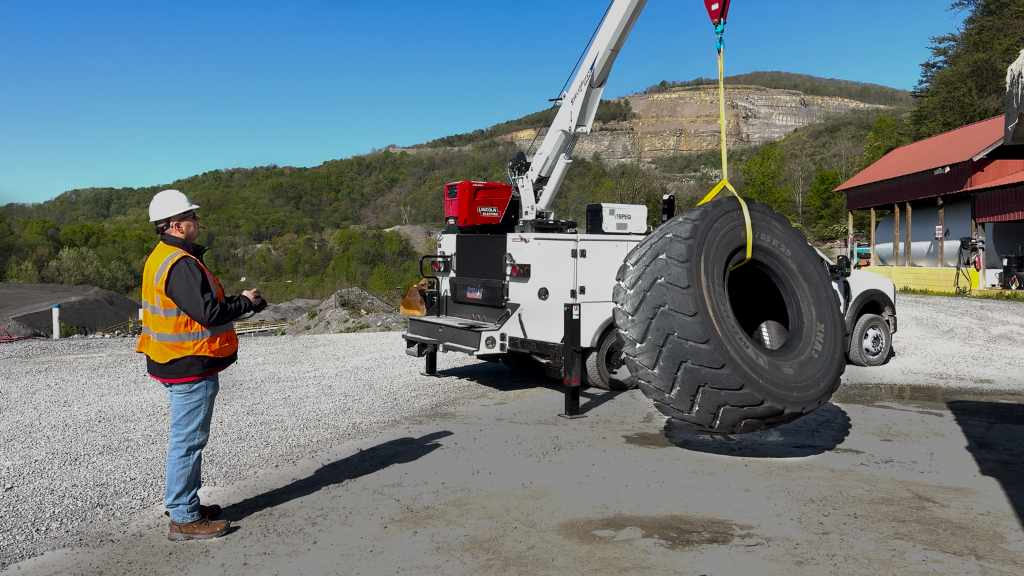
MidSouth Aggregate’s approach, using a Ford® F-550 platform, offers a practical template for other mining operations. Rather than pursuing full electrification or sticking with traditional systems, they built what effectively functions as a hybrid solution using Vanair’s EPEQ® Electrified Power Equipment® components.
The truck’s configuration centers on three main electrified systems. An EPEQ® AIR45 Rotary Screw Air Compressor handles pneumatic tool requirements and tire service. An EPEQ® EPTO system powers a hydraulic crane for lifting cylinder heads, transmission assemblies, and other heavy components. The EPEQ® Idle Management (EPEQ® IM) technology intelligently manages when the truck’s engine runs versus when equipment operates on battery power. Two EPEQ® ELiMENT® Batteries power the components so the truck can remain off during operations.
They also included an EPEQ® WELDER140 stick welder for routine repairs and integrated a Lincoln Electric Ranger® 330MPX™ engine driven welder/generator for more demanding welding tasks. This dual-welder approach gives technicians flexibility, offering a battery-powered unit for most jobs and an engine-driven Ranger® for demanding structural repairs and fabrication work.
What makes this setup work is the intelligent power management. The system doesn’t try to run everything on batteries all the time. Instead, it uses stored battery power when possible and brings the engine online only when necessary to recharge or handle heavy loads. This approach delivers immediate benefits without requiring wholesale changes to how technicians work.
Real-World Performance
The results from 18 months of operation validate the hybrid approach. Fuel consumption dropped from 10 to 15 gallons per service call to two to three gallons, roughly an 80 percent reduction. That translates to thousands of dollars in annual savings on a single truck. Maintenance costs decreased because the engine runs significantly less. Fewer operating hours mean extended oil change intervals, less wear on engine mounts and exhaust components, and longer periods between major service events. The EPEQ® components themselves require minimal maintenance beyond routine inspections.
In mining, where equipment performance directly impacts productivity, Long has gained raving fans. His technicians, who were initially skeptical about battery-powered equipment in a quarry environment, now prefer the electrified setup to traditional systems.
The EPEQ® EPTO system for the crane has proven particularly effective. Technicians have reported smoother operation and better control compared to mechanical PTO systems. The absence of engine noise and vibration during crane operation makes the positioning of heavy components easier and safer.
Learning Curves
Not every aspect of the transition went smoothly. The biggest challenge was psychological rather than technical. Experienced technicians accustomed to hearing an engine run during service calls had to adjust to the quieter operation. Some initially worried that battery-powered equipment wouldn’t deliver sufficient power for demanding applications. Long addressed this through mandating hands-on training and by letting performance speak for itself. Once technicians experienced the system’s capabilities first-hand, their concerns dissipated.
The lesson here: plan for change management, not just equipment installation. The other learning involved working with manufacturers of bodies. MidSouth Aggregate partnered with other organizations who had experience with electrified systems. That expertise proved valuable in optimizing battery placement, wiring, and component accessibility.
For any operations attempting similar upfits they should seek body builders familiar with electrified systems rather than trying to retrofit existing trucks without proper planning.
Practical Considerations
For mining operations considering similar approaches, several factors merit attention:
- First, accurately assess power requirements. Understand what equipment needs to run, for how long, and under what conditions. EPEQ® systems are modular, allowing configuration for specific needs rather than one-size-fits-all installations. This means that users do not have to sacrifice performance for electric-powered equipment.
- Second, recognize that this isn’t an all-or-nothing proposition. The hybrid approach—combining battery power for routine operations with engine power for heavy loads and recharging—delivers benefits without requiring complete operational changes. Technicians still have the engine available when needed.
- Third, consider the total cost picture. Yes, electrified systems carry upfront costs. But fuel savings, reduced maintenance, and improved equipment longevity create payback periods shorter than many fleet managers expect.
- Finally, think about operational flexibility. Quieter equipment opens up work possibilities in areas where noise concerns previously created restrictions. As quarries expand closer to developed areas, this advantage becomes more valuable.
A Paradigm Shift
The mining and aggregates industry hasn’t rushed to adopt electrification, and for good reason. Operations need equipment that works reliably in punishing conditions. But MidSouth Aggregate’s experience demonstrates that thoughtfully designed electrified systems can handle demanding applications while delivering measurable operational benefits. Long is already planning to spec his next service truck with EPEQ® components. For mining operations watching fuel costs, managing maintenance budgets, and dealing with increasingly stringent environmental regulations, that’s the kind of endorsement worth considering.
Vanair®, the Vanair® logo, Mobile Power Solutions®, EPEQ®, Electrified Power Equipment®, and ELiMENT® are registered trademarks or trademarks of Vanair®, a Lincoln Electric Company, Michigan City, IN, USA. Lincoln Electric®, the Stacked Oval Logo, Ranger®, and 330MPX™ are registered trademarks of The Lincoln Electric Company and its related companies. All trademarks and registered trademarks are the property of their respective owners.